


This Ends in Blood
To Play is the Thing in Teen-centric
Macbeth Adaptation for High Schoolers
Signature In the Schools, Signature Theatre, Arlington, Virginia
Monday, January 19, 2026, C-411 (lower corner of bleachers on one side of box theater)
Streaming September 18–28. 2026
Directed by David Zobell
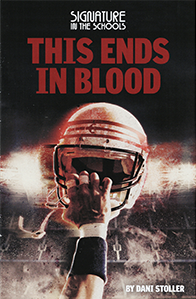 Playwright Dani Stoller's This Ends in Blood transplants William Shakespeare's Macbeth to the realm of current-day, American high school football. Shakespeare's King Duncan and his thanes are a quarterback and his teammates plus Banquo, the equipment manager. In their company are their cheerleaders, including Mac's girlfriend, Beth. The witches are a clique of goths who hail Mac as third receiver, as first receiver, and as the quarterback! Bringing all this to life are teens playing the teens at Signature Theatre in Arlington, Virginia.
Don't shake your head in Shakespurity disdain. The production, which had only two public performances (plus five for public school groups) was one of the richest nights of theater I've ever experienced. It had an encore performance on Signature Theatre's streaming platform this September, reviving my first impression of the acting which was further enhanced by the filming's efficient yet dramatic editing.
The play's success starts with Stoller's clever script, translating Macbeth's culture and imagery into high school life. Equally important is Stoller's skills in conceptual comedy, which hitherto I've seen only in her stage performances. For This Ends in Blood, Stoller's comic instincts not only mine Shakespeare's own comic touches in Macbeth, they also create a natural throughline of ironic comic moments. And still, the play's tragedy is real: there is blood, there is self harm, and, beyond that, there is a reckoning for our modern social standards.
Most of all, this is a valuable tool in high school education for the students on stage and in the audience. This Ends in Blood is the Signature in the Schools program's 31st production, a program that could be a model for theaters that want to grow ongoing generations of theater practitioners and audiences. See the Aside below for a summary of the Signature in the Schools program.
The production process starts with Stoller and the play's director, David Zobell, Signature Theatre's director of education, soliciting students and schools on subject matter. They glean their ideas from the Arlington Public Schools social studies and English high school curricula, looking for a topic they feel is presently relevant that they then begin researching and writing. Two words in that description are key to the choice of Macbeth and Stoller's approach to Shakespeare's script; those words are social studies.
The success of This Ends in Blood relies most on how the cast of teens produce and perform the play written for them in their language—mostly. The acting company comprises 30 students and the production company 14 students from 12 high schools in the region. They are seniors, juniors, sophomores, and freshmen drawn from English, social studies, and theater classes. The acting company has one adult (who doubles as Mac's father and the rival school's coach), and overseeing it all are 14 members of the "Adult Production Team," including Zobell and Stoller. What the audience gets is a full-on professional-quality production of an original play with teenagers doing much of the work backstage and 98 percent of the performance on stage.
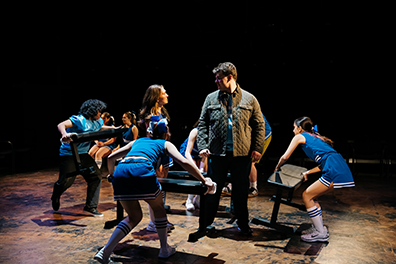
Mac & Beth (Lukas Simcox, vrmyrt right, and Jacqueline Lutz, center left) finish a conversation as cast members begin transitioning the set for the next scene in the Sinature in the Schools production of Dani Stoller's This Ends in Blood at Signature Theatre in Arlington, Virginia. Photo by Cameron Whitman.
This version of the Macbeth story is centered on the high school social strata in which Mac (Lukas Simcox) and Beth (Jacqueline Lutz) must navigate their lives. Hanging over this pathologically insidious cliquedom manifested in high school hallways and cafeterias is the toxically competitive culture manifested in the institution of high school football—a toxicity inflated by adults. "It's kind of creepy, actually," says Banquo (William Waugh): "All these, like, 40- and 50-year-olds so hyper focused on whether or not a bunch of teenagers play a game correctly."
The underpinning foundation of Stoller's take on Shakespeare's tragedy is the all-too-real stressors that the current generation of kids have to deal with. This adds an intriguing angle to Stoller's portrayal of Shakespeare's Macbeths. I've seen Macbeth and his lady played in a variety of moods and motivations, from raw ambition and evil souls to painful pasts and post-traumatic stress disorder (PTSD). This is the first time I've seen them depicted as social laggers, his mediocrity inciting abuse from his businessman father, her family status leaving her stuck at the bottom of the social pyramid—literally.
Turning rival high schools competing for dominate bragging rights via football into a parallel for Scots and Vikings battling for dominion of a nation is a bit of stretch. Stoller pulls it off by relying on the tendency of American football fans to approach the sport as an allegory for warfare. Shakespeare's Macbeth, the Thane of Glamis, wins the battle by unseeming the Norse commander "from the nave to th' chops." Stoller's Mac, a third-string receiver playing for Dunsinane High against the Norwegian Prep Vikings, leaps to snare a pass intended for Dunsinane's first-string receiver and "dancing his way towards the end zone for the winning touchdown." That first-string receiver's name is Cawdor. The Thane of Cawdor is the traitor in Macbeth, and Cawdor is here, too: he had been fumbling every pass thrown to him apparently in cahoots with the Vikings players.
This opening scene is the first of a continuing string of Macbeth references in names, geography, and lines that Stoller uses in her play. Some are intended as comedy; others she uses to flesh out characters or drive the plot and drive home her script's thematic essence.
Shakespeare presents Macbeth from the start as an exemplary warrior, and does so with Banquo, too. Stoller's Mac loves football, but he's third string, and Banquo's family has never produced a football player. "That's why I'm team manager and not on the field," he says.
Mac being relegated to the bench stings his father (Danny Gavigan) more than him. Dad was a football hero when he was attending Dunsinane High and constantly berates his "mediocre" son when he's not ignoring him. "Almost isn't good enough" Mr. M says to his son, then yells at his wife who accuses him of being too hard on Mac. "You want to waste all this time driving him to and from practice, all this money on uniforms if he's just gonna be mediocre?" he shouts at her—whom we never see—and concludes that "We have very different views on what it means to be a good parent."
For his heroics in the game against Norwegian Prep, Mac called on his determination to get Dunsinane the win needed to play in the championship game against their chief rival, Birnum Wood. That Mac can't fathom how he pulled off the catch and touchdown run is his first sense of what he sees as something supernatural happening around him—not unusual in a teenager. This is his frame of mind when, as he and Banquo are exulting over Mac's heroics, the skies turn stormy. "These clouds—they came out of nowhere, right?" Banquo says. "Yeah," Mac replies. "God, I have never experienced a day that was so bad and so good at the same time." It's the fair is foul observation ahead of meeting the three witches (Sev Conley, Ani Veeraraghavan, and Winter Flynn). "No wonder the clouds are rolling in," Banquo says to the three goth girls. "It's not nighttime yet: shouldn't you still be in your cave? Or under your bridge? Wherever you trolls hang out." After the witches respond with their hails to Macbeth, they acquiesce to Banquo's demand that they foretell his future: he is "lesser than Mac but also greater" and "not as happy as Mac, yet much happier" and, number three, "Your blood will be quarterbacks, even though you will not be one." Well, that's obviously never going to happen in his family, he contends.
Of all the plotlines in Shakespeare's Macbeth, Stoller hews most closely to that of the witches, including the apparitions. She also does a bit of equivocation of her own layered on that of Shakespeare's witches. After all, if you are willing to believe in Shakespeare's weird sisters, you are likely to believe in Stoller's "witchy girls."
Stoller's plotline for Mac is a harder sell, though she does manage to come up with a suitable way to off the starting quarterback, Duncan (Deacon Crenshaw), via drunk driving. Mac pins the blame on Duncan's two freshmen handlers, Gus Char as Boofter and Dominic Gavito as Grizzle: not Shakespearean character names but the product of Duncan feeling so entitled he can create new names of his own liking for his inferiors. Instead of a dagger, Mac sees a bloody football jersey before him as he prepares to launch Beth's plot on Duncan, a jersey that reminds Mac of his father.
"My dad wore one just like you, once," Mac says to the jersey. "There are photos of him in it all over the living room. But his wasn't…" and that's when he sees blood on the jersey. Mac ponders the fate beyond his hand reaching for the jersey. "Maybe this once, almost is good enough," he says, turning his father's favorite inspirational phrase on its head. "The more I think about what it would take to have you," Mac continues, addressing the jersey, "the less I think I want it. But still"—he pauses—"Still, even covered in blood, I want it," and Mac grabs the jersey.
It's notable that one of the rare times Stoller goes pure Shakespeare in her script comes after not one but two ghosts appear at Mac's celebratory party, Duncan and Banquo. Mac tells Beth, "It will have blood. That's what my father always says. Blood will have blood," and goes on to finish Macbeth's original speech at the same point in the plot:
Stones have been known to move, and trees to speak. Augures and understood relations have by maggot-pies and choughs and rooks brought forth the secret'st man of blood.
Stoller gives Macbeth's allegory multi-metaphoric meanings across generations. Mr. M is also the third apparition, warning Mac about Great Birnum Wood coming to Dunsinane High field against him.
One of the play's most tragic moments comes not with blood or self-harm, but in a phone conversation between Mac and Mr. M, when he finally shows his son care and respect only: after Mac has been named starting quarterback. "You know, after I busted my ACL, I really felt like my dreams of a future in football were over," Mr. M, tells Mac. "And now, well, it sems like those dreams are possible again. Through you." Yes, he says he's proud of Mac and is "man enough" to admit he was wrong thinking his son didn't have it in him: "You have proven yourself man enough to do what needs to be done to win," he says in his own language of conditional love. It's not the words that carry the emotional weight of this scene, but how Zobell stages it. Though they are conversing on the phone, father and son are sitting next to each other. It's the closest they get to each other physically, and yet the space between them is still insurmountable.
The death of Duncan and apparent murder of Banquo are not intended by Mac; rather, he sees the consequences of his actions as steps toward his ordinated destiny. This drives him into a state of paranoid despotism, especially as Duff the running back (Cooper Short), turns against him and starts plotting with Duncan's protégé, Malcolm (Roberto Valentin III) to bring Birnum Wood to Dunsinane. Mac declares the absence of Duff and his sister, Lizzie, "treasonous." "He said that?" says football player Lennox (Loic Razanakoto) to cheerleader Amy (Angelina Kaminsky) relating this account. "Dude, it's not treason. It's football." He's not the only player with that perspective. Says Duff: "Wouldn't it be fun if we actually remember that football is a game?" Replies Rose (Sefanit Equbazge), the team's leader in gossip: "Tell that to the alumni association."
In lieu of Shakespeare's Macbeth ordering the destruction of Macduff's family, Stoller's Mac gets Lizzie (Lily Glista) kicked off the cheerleading team. This might not seem to be an equivalent level of evil or destruction, perhaps, but that's in the eye of the beholder. And Lizzie, who is top of the pyramid—more than allegory as she is at the height of the cheerleaders' feet-on-shoulders human triangles—is devestated. "Do you have any idea how hard I have worked for this team?" she starts, and describes five a.m. wakeups, running 10-plus miles a day, memberships in "like, three different pilates and barre studios," and weighing after "every meal, to make sure I was the perfect size to be top of the pyramid." This earns chuckles from the audience, but the tone turns serious when she screams, "I am nothing without this." Her character arc ends with word that she's in the hospital.
Where Stoller turns the table on Shakespeare by contributing character dimensions to his play is in her portrayal of Beth. Shakespeare provides only an obtuse back story for Lady Macbeth. She was sometime a mother, and in the play she and her husband are passionately in love with each other, though I've seen productions emphasize a passive-aggressive nature instead of real love. Lady Macbeth displays an extraordinary amount of ambition, but whether entirely for her husband or for herself, too, is in the actors' interpretations. And she's impatient; why wait for the witches' prediction of Macbeth becoming king hereafter when they can make that happen here and now? Or, as Beth puts it to Mac, "I'm suggesting that we just find a way to move the witches' prophecy along. If it's gonna happen anyway."
Except being a sometime mother, Lutz's Beth has all of Lady Macbeth's traits but is driven further by her fears of being socially substandard. Her family is not monied like that of her peers, so she feels she has to work harder at her schoolwork and after-school activities. One of her scenes begins with a voice-over of students describing the stress of being an athlete and keeping up with schoolwork. On stage, four football players with their feet perched on a blanket-covered table do pushups while single-handedly turning pages of textbooks on the floor between their hands, Rocky Balboa style. As Beth enters, the players exit, leaving behind their opened textbooks, and the scene transitions into Beth's bedroom where she is fervently cramming for a test. "I am a straight-A student, I belong to, like, every extra-curricular activity, even the weird ones," Beth tells her sister, Sierra (Ava Spera), who got a scholarship to MIT. "You jumped two grades and were being labeled a genius at age 11," Beth complains when her sister tries to provide her personal experience advice. "You are not the norm. Some of us are born brilliant, while others of us have to work at it."
Beth's primary social validation comes from being a cheerleader, and most odious to her is being stuck at the bottom of the pyramid. Colleges don't "give a ton of athletic scholarships to the girls who are at the bottom of the pyramid," she says. "But unfortunately for me, Lizzie Duff is top of the pyramid, because the Duffs are a legacy family and, like, the biggest donors of all time." In pushing Mac toward their plot to sideline Duncan, Beth gives a lengthy speech about a mouse caught in a trap. Beth's mother drowned the mouse so that it wouldn't continue struggling to chew off its arm to escape. Though her mother tried to hide it, Beth says she had to watch the drowning "so that this little mouse, like, knows that her life had meaning." Beth was terrified of becoming that mouse. "Of feeling like my whole life is just gonna be me being stuck and no one noticing. And I just want one moment, like, one, shining freaking moment, where the struggle is worth it. And I can finally feel like I am one of them, and not like I'm so exhausted by life I'm willing to rip off my own arm with my teeth to get free of it."
This is Beth's equivalent of Lady Macbeth's "I have given suck" speech, and it's tantalizing to think Lady Macbeth might be driven by a similar inferiority complex. One potential clue in creating such a plotline comes in King Duncan's sequence of praising Macbeth's actions in the war and then promising that the king "will labor to make thee full of growing." But almost immediately after that promise, the king announces his son as heir to the throne (not a given in Scottish royalty). The manner in which Duncan plays out this sequence has no stage directions to guide us; all we have to go on is how it discombobulates Macbeth into murderous meditation. Stoller's script has inspired me to wonder how Macbeth might play if at that moment and subsequent lines Duncan were played with an air of passive aggressive privilege that he uses to mess with the thanes, a la Duncan in This Ends in Blood. It's a textual pinprick, but such dynamics could then be at play in Lady Macbeth's murderous turn, too.
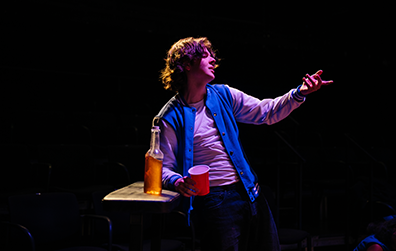
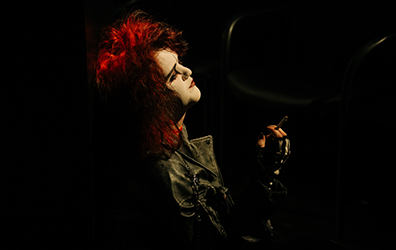
Above, Duncan (Deacon Crenshaw) parties with the "murder weapon" in his hand, in the Signature in the Schools production of Dani Stoller's This Ends in Blood at Signature Theater in Arlington, Virginia. What's in the cup is not poison in the Shakespearean sense. Below, First Witch (Seve Conley) awaits the arrival of Mac and Banqoe. Photos by Cameron Whitman.
When Beth meets Mac after he's sent quarterback Duncon to his unforeseen death, instead of holding bloody daggers in his hands, Mac is holding Duncan's red cup. Beth grabs it from him to keep Mac from having any association with Duncan before his drunken drive. As she does so, Beth spills red liquid from the cup onto her cheerleading uniform, a stain that doesn't come out. Beth's subsequent slide into depression mirrors that of Shakespeare's Lady Macbeth, but Stoller has Beth poignantly predicting her own end. "You need to take a break," Sierra tells her. "No, I don't," Beth replies. "I can take a break when I'm dead." Though it's Lizzie Duff who equates being kicked off the cheerleading team as worse than death, we can stretch that allegory to Beth, especially as Lutz plays Beth with a frantic edge.
This Ends in Blood personifies the most prominent danger facing teens today: stress. The opening scene has uniformed football players and cheerleaders doing high-energy exercises as voice-over newscasts and interviews describe the academic and social stressors that have contributed to the rising rate of suicide among teens in recent years. Boys must heighten their efforts to extreme levels in order to be winners. Girls must raise their efforts to extreme heights in order to feel worthy, which is literally the case with Beth. A teenager's community is no longer confined to a neighborhood, school, and activities of shared interests: it's become an internet-connected world that has expanded their realm of opportunities and social options but also the competition, bullying, and poisonous influences that come with it.
In a Shakespearean way, This Ends in Blood collapses time and thus doesn't linger long on the deaths; there's hardly time even for the characters to grieve. Stoller also keeps the comedy going, emulating Shakespeare but also poking fun at his tropes. The new team Mac creates after his teammates have left him includes characters with the names of Servant, Doc, and Seyton—"Satan?!" an alarmed Mac responds. "My God, you guys are really losing in the names department, huh?" The final fight between Duff and Mac is nothing more than a typical high school brawl, and we slide into the moral of the play—just let the players play—in a disjointed finale that even channels Romeo and Juliet, Shakespeare's one true teen play.
Ultimately, the gravatas of what happens to Shakespeare's Macbeth at Dunsinane—a tyrant who brought his country to ruin and ends up beheaded for his efforts—is beyond the grasp of Stoller's characters attending Dunsinane High. This emerges in a fourth-wall breaking joke after Duff officially addresses Malcolm as the new starting quarterback. Whereas Shakespeare's Malcolm announces that all thanes will henceforth be earls, Stoller's Malcolm announces that "Like, yes, positions matter. There is a heirarchy in some ways, there is no denying that. But I don't want to turn into Mac, and I don't want any of us to go that way, either. Things like this, like football, like theater—" and that unleashes a hilarious passage of actors being actors, be they Equity or high school.
On the whole, This Ends in Blood reflects the production values of the Tony Award-winning Signature Theatre's professional productions and, frankly, it has the acting chops, too. The high school students in this production are an accomplished ensemble, a tight company of actors who richly render their characters with studied precision. Zobell's direction keeps the action constantly moving, including the cast's management of quick scene changes. Zobell uses the square theater's corner exit halls to extend the scene's geography, whether it's Mac's touchdown run or the teens entering and exiting the alcohol-infused party at Duncan's mcmansion home. All this and Stoller's script proves to be both a derivation of Macbeth and a contribution to the social studies Shakespeare's play has long inspired.
Eric Minton
September 27, 2026
Comment: e-mail editorial@shakespeareances.com
Start a discussion in the Bardroom
